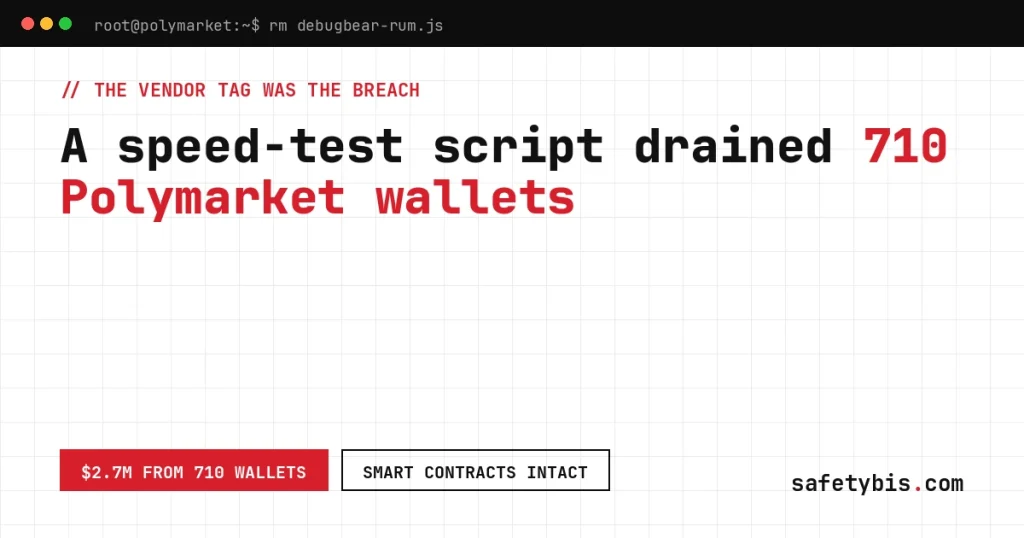
A Polymarket third-party script hack on October 29 let an attacker swap a DebugBear monitoring tag for malicious code that sold positions and pulled about $2.7 million from 710 wallets. No smart-contract breach was reported. The weak point was a script the site trusted, and most business websites load several just like it.
Key takeaways
- An attacker swapped DebugBear's monitoring script on Polymarket.com on October 29; about $2.7M left 710 wallets, per third-party estimates.
- The script used live sessions to sell positions and move funds. No smart-contract breach was reported.
- Polymarket is returning $3.9M, including $1.2M for pause losses.
- CSP and SRI would not have stopped it. Runtime monitoring of third-party code is the missing control.
What Polymarket did in the first hour
Polymarket halted trading on its international exchange on Thursday, October 29, after users reported withdrawals they had not made, days before the November 3 US midterms. It moved to cancel-only mode around 2:00 p.m. ET and resumed trading at 3:00 p.m. ET. The separate US platform was not affected.
The team removed the compromised code, cleared caches, paused trading and relayer actions, and reset active login sessions. The session reset cut the attacker off. A cache purge alone only stops new visitors from receiving the bad file; it cannot undo code already running in an open tab.
Who lost money, and who is getting it back?
Blockchain analytics firms Betting Intelligence and Polysights estimate that about $2.7 million left 710 wallets.
“In total, we’re returning $3.9M to traders: the $2.7M plus $1.2M to cover pause-related losses. No claims or tickets needed: we identified eligible wallets from on-chain and trading data.” (Polymarket)
Losses under $10,000 were due to be refunded by Friday, October 30; larger losses require a release form. By that Friday afternoon, Polymarket said 95% of affected wallets had been refunded. Because no claims are needed, any message asking for a seed phrase or private key is a scam.
How did the Polymarket third-party script hack use live sessions?
A third-party script runs with the same browser privileges as the page that loads it. DebugBear, a UK website-performance vendor, supplied the real-user monitoring (RUM) script on Polymarket.com. Polymarket says the attacker replaced it with malicious code that, for users with the site open during a short window, used their active sessions to sell positions and move funds out of their wallets.
In our reading, strong login security could not have stopped this. MFA protects the sign-in step. HttpOnly cookies stop a script from reading the session token, but not from making requests the browser sends with it. The server would have seen valid sessions calling normal endpoints.
DebugBear acknowledged an “ongoing security incident” and told RUM customers to remove the embedded code. Polymarket referred the case to UK law enforcement.
What should you ask every vendor whose code sits in your header?
Gareth Bowker, head of information security at Jscrambler, told HackRead the malicious script talked to a server on DebugBear’s own domain, so a content security policy allowing that domain would have let the traffic through. Subresource integrity helps little on RUM tags, which vendors update often. Static controls are necessary but not sufficient; you also need to watch what third-party code does in the browser at runtime.
For every third-party tag on your site, ask:
- Who hosts the file, and who at the vendor can publish a new version?
- Can you remove it in minutes, including tag-manager containers and CDN copies?
- Does it load on checkout, the customer portal or the admin console? A performance tag rarely needs to.
- Who in your company hears when the vendor declares an incident?
Software supply chain security testing checks your tag inventory against what your pages actually load. Polymarket has been here before: in June, vendor-injected code took about $3 million from its users. Crypto front ends can test this path with crypto and Web3 penetration testing.
What an IT manager does in the first afternoon
Capture evidence, pull the tag, then purge. Polymarket’s sequence, with a snapshot step added first, works for any checkout or customer portal:
- Snapshot the served JavaScript, tag-manager publish history, CDN objects, logs and a browser HAR file. A purge destroys the artifact your investigation needs.
- Remove the tag everywhere: site code, tag manager, cached pages and regional CDN endpoints.
- Pause payouts, bank-detail changes and exports, then invalidate active sessions.
- Correlate session logs with orders, refunds and account changes across the exposure window.
- Tell customers what to check. Bowker advises Polymarket traders to review transaction history and revoke token approvals they do not recognize, a separate step from logging out.
Afterward, compare the tags marketing says you run with what a logged-in page actually loads. Our data breach response team works from exactly these logs.
FAQ
Were Polymarket's smart contracts hacked?
No. The theft ran through a compromised DebugBear script that abused active sessions on Polymarket.com.
How much was stolen from Polymarket wallets?
About $2.7 million from 710 wallets, per Betting Intelligence and Polysights; Polymarket is returning $3.9 million including pause-related losses.
Not sure which third-party scripts run on your logged-in pages, or suspect one has been tampered with? Our threat hunting and compromise assessment team can give you a clear answer quickly.
Tell us what you're running
Scoping is free. We reply within one business day, and under 30 minutes for active incidents.