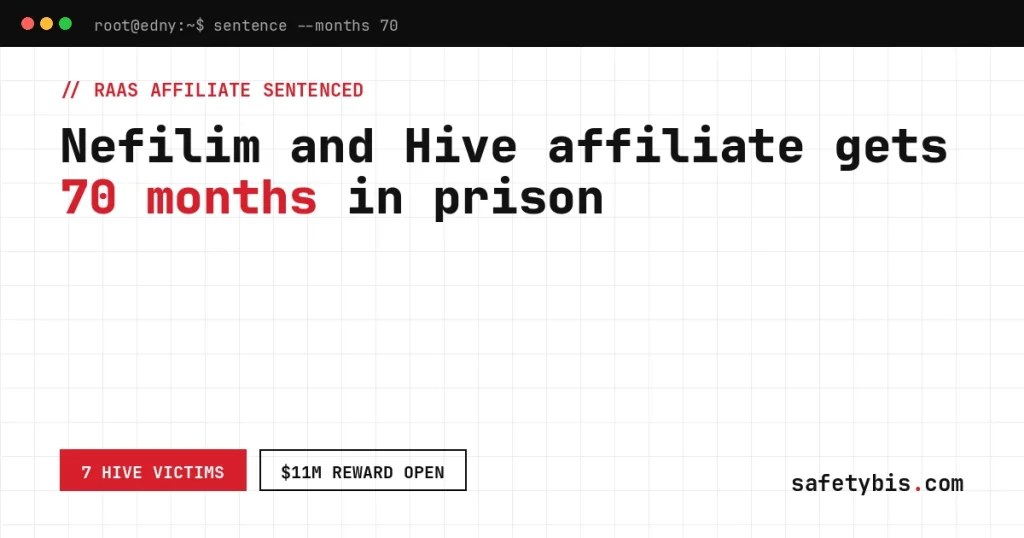
A Nefilim ransomware affiliate sentenced in Brooklyn on 28 October 2026 will spend 70 months in prison. Artem Stryzhak, a Ukrainian national, was also one of Hive's earliest affiliates and hit law firms, a dentist's office and a healthcare provider. His case shows how small firms get chosen, priced and squeezed, and why a sentence years later closes none of those incidents.
Key takeaways
- Nefilim ransomware affiliate Artem Stryzhak was sentenced in Brooklyn on 28 October 2026 to 70 months for Nefilim and Hive attacks.
- He paid Nefilim administrators a 20 percent cut; each victim got a custom build, unique key and tailored note.
- His seven Hive victims included law firms, a dentist's office and a healthcare provider; stolen data and attacker access from 2021 may still be open problems.
- Alleged Nefilim administrator Volodymyr Tymoshchuk is still at large, with a reward of up to $11 million.
Who is the Nefilim ransomware affiliate sentenced in Brooklyn?
U.S. District Judge Pamela K. Chen sentenced Artem Aleksandrovych Stryzhak to 70 months in prison, or five years and ten months, on 28 October 2026, the U.S. Attorney’s Office for the Eastern District of New York announced.
Stryzhak pleaded guilty in December 2025 to conspiracy to commit fraud, extortion and related activity in connection with computers. He was arrested in Spain in 2024 and extradited to the United States in April 2025.
The announcement, as reported by Security Affairs, does not mention restitution, forfeiture or supervised release, and gives no figure for Stryzhak’s own proceeds or for any single victim’s losses.
How did a Nefilim affiliate get paid?
Nefilim ran as ransomware-as-a-service (RaaS). Around June 2021, its administrators gave Stryzhak access to the code in exchange for 20 percent of his ransom proceeds. He launched attacks from his own account on their online platform, while they maintained the malware and the leak sites.
Three details matter to defenders:
- Victims were picked, not stumbled on. Stryzhak and co-conspirators searched online databases for a target’s net worth, size and contacts. If your revenue estimate is public, an affiliate can price you before touching your network.
- Every attack got its own build. Each victim received a customized executable with a unique decryption key and a tailored ransom note. One company’s key is useless to the next.
- Encryption was only half the threat. The crew copied data out after getting in, and Nefilim notes warned that files would appear on “Corporate Leaks” sites run by the administrators.
In June 2021, one attack hit a company in the oil and gas transportation industry. Stryzhak stole its data, and about a week later he created the email addresses used in the ransom note. He kept deploying Nefilim through at least October 2021.
That is why backups never settled these cases. A clean restore brings systems back but does nothing about files already on an attacker’s server.
Which Hive victims show the risk to clinics and law firms?
As one of Hive’s earliest affiliates, Stryzhak and co-conspirators hit seven victims during the COVID-19 pandemic, including law firms, a dentist’s office and a healthcare provider. None could reach their encrypted data. One avoided paying: during its months-long effort to disrupt Hive, the FBI gave that victim a decryption key, and it recovered its data without paying a ransom.
Prosecutors say the wider Hive conspiracy attacked about 1,500 victims worldwide between June 2021 and January 2023, including government entities, hospitals and businesses. One hospital had to give up digital technology to treat its patients and could not admit new patients immediately after the attack.
The announcement does not say how any of Stryzhak’s victims were breached, so the checks below are places to look, not a reconstruction of his method.
Who is still wanted, and what is the $11 million reward?
Volodymyr Tymoshchuk, Stryzhak’s co-defendant, whom prosecutors call a Nefilim administrator and serial ransomware developer, remains at large. The State Department’s Transnational Organized Crime Rewards Program offers up to $11 million for information leading to his arrest, conviction or location.
U.S. Attorney Joseph Nocella, Jr. said authorities “remain determined to capture” him and credited the FBI New York Field Office, the Justice Department’s Office of International Affairs and its Computer Crime and Intellectual Property Section, and Spanish law enforcement. Tips go to the FBI at +1-917-242-1407, a local field office or, outside the U.S., the nearest U.S. Embassy.
What should an SMB do if Nefilim or Hive ever touched its network?
Treat a 2021 or 2022 ransomware incident as closed only if you can prove it. A guilty plea does not delete files posted on a leak site or remove an account an attacker created, and paying a ransom never proved the stolen copies were destroyed.
Owners and managers should settle two questions:
- Did the stolen data trigger notification duties that were never met? Ask counsel, especially if you hold patient or client files.
- Who is in the stolen files? Assume the data is still in criminal hands and warn those clients about targeted phishing and invoice fraud.
IT and security teams should check:
- Remote access: VPN accounts, exposed RDP, remote-support tools. Remove anything nobody can explain and enforce MFA on what stays.
- Accounts created or granted admin rights during the incident window. Disable any that no one requested.
- Every credential that existed at the time, including service accounts and hypervisor root passwords. Rotate them from a clean admin machine.
- Backups. Confirm they are offline or immutable, so an intruder cannot encrypt them along with production.
A decryption key, even one from the FBI, restores availability, not safety. Picture a clinic that decrypted in 2022 and went straight back to work: the files open, but an admin account added during the intrusion may still be live. Before reconnecting restored systems, find the initial access, remove persistence and revoke active sessions.
If you were never sure what happened back then, threat hunting gives an evidence-based answer. If files are encrypted today, start with ransomware recovery, and if stolen data is the bigger worry, our data breach response team handles scoping and notification.
FAQ
How long was Artem Stryzhak sentenced to prison?
70 months, or five years and ten months, imposed by Judge Pamela K. Chen in Brooklyn on 28 October 2026.
Did every Hive victim have to pay?
No. One of Stryzhak's seven Hive victims got a decryption key from the FBI and recovered its data without paying.
Is Volodymyr Tymoshchuk still at large?
Yes. The State Department offers up to $11 million for information leading to his arrest, conviction or location.
Should a small clinic or law firm still worry about a 2021 ransomware incident?
Yes, unless someone verified that the entry point was closed, credentials were rotated and notification duties were met. Stolen client or patient data may still be in circulation.
If a ransom note appears tomorrow, the first hours decide which evidence survives. An incident response retainer puts our responders on call before that happens.
Tell us what you're running
Scoping is free. We reply within one business day, and under 30 minutes for active incidents.