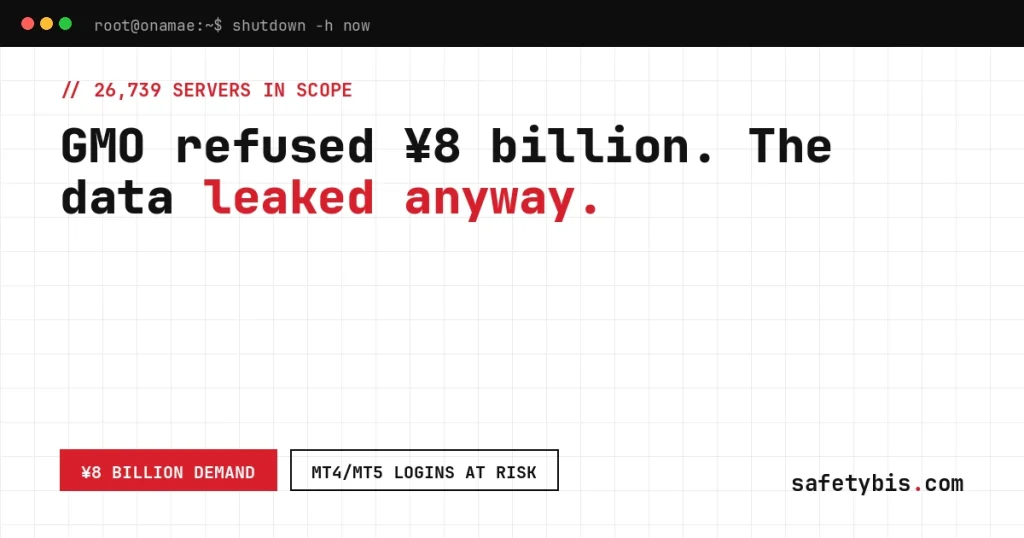
The GMO Onamae Desktop Cloud breach may have planted malware on up to 26,739 customers' servers, and GMO Internet has confirmed that stolen company and customer data went online after it refused an ¥8 billion ransom. MetaTrader logins may also be exposed.
Key takeaways
- GMO detected the intrusion on 20 October; up to 26,739 customers' servers may carry malware.
- GMO refused an ¥8 billion ransom, and the attacker published company and customer data.
- The attacker appears never to have triggered ransomware, but no indicators are public, so a clean scan proves little.
- Rotate MT4/MT5 master and investor passwords separately from the VPS login.
What happened in the GMO Onamae Desktop Cloud breach?
GMO Internet, one of Japan’s largest domain registrars, runs Onamae Desktop Cloud, a popular VPS service in Japan. It detected an intrusion on 20 October that may have installed malware on up to 26,739 customers’ servers, and shut servers down and reduced service availability before investigating.
No actor, ransomware family, entry point, CVE or indicator of compromise has been disclosed. GMO refused the ¥8 billion (about $50 million) demand and offered each customer ¥5,000, roughly $30.
On 26 October, GMO warned that the actor planned to leak customer data and trigger ransomware planted on customer servers. The next day, working with Trend Micro, it told customers to back up and cut every connection before noon:
Once you have a backup, disconnect the network, power it down, and unplug the cord that connects to your PC.
GMO offered equivalent replacement PCs to anyone damaged by ransomware. It later confirmed that company and customer data had been published and is considering further compensation and threatening legal action against anyone who spreads it. According to BleepingComputer, the attacker appears never to have acted on the ransomware threat.
Why does a hosting breach put trading accounts at risk?
GMO’s own warning says MT4 and MT5 credentials and trading-account details may have been exposed or compromised. Payment information, it says, was not.
A bank can reissue a card number. A MetaTrader master password lets someone place trades; an investor password gives read-only access. Resetting the Windows password on the VPS changes neither.
The route matters too. The attack reached customers through the provider’s platform, a path tenants’ own firewalls and endpoint tools never inspect.
What does this change for businesses that rent a VPS or cloud desktop?
Any business on rented servers should ask:
- Which providers can push code to machines that hold credentials or money-moving access?
- Is there a backup outside that provider’s admin control?
- How fast can you rotate privileged passwords and end sessions?
- Would you learn about a provider breach before your customers do?
For EU financial entities, a breach like this is a third-party ICT risk event under DORA, which expects a register of ICT providers, exit plans and resilience testing. NIS2 brings cloud and hosting providers into scope, giving customers grounds to demand prompt incident notification in contracts.
The real test is whether your controls hold once the host itself is compromised, which is what cloud penetration testing and DORA penetration testing measure.
What should Onamae Desktop Cloud tenants do now?
Keep servers off until GMO officially clears them; it has given no restoration timeline. Meanwhile:
- From a clean device, rotate MT4/MT5 master and investor passwords, then end active sessions.
- Review trade history, open positions and Expert Advisor settings, and report anything unexpected to the broker.
- Treat every leaked password as compromised; a takedown cannot recall copies already circulating.
- Keep a backup outside the provider’s account and credentials.
Practitioner’s note: GMO has published no hashes or attacker tools, so a clean antivirus scan proves little on a VPS the attacker could write to through the provider’s platform. In our engagements we rebuild from a known-good image and restore data selectively, the core of compromised server recovery.
FAQ
Did GMO pay the ransom?
No. GMO refused the ¥8 billion (about $50 million) demand, and the attacker then published company and customer data.
Was ransomware activated on Onamae customer machines?
According to BleepingComputer, the attacker appears never to have acted on the threat. That does not prove the staged malware is gone, so rebuild rather than keep using the server.
Were MetaTrader 4 and MetaTrader 5 passwords stolen?
GMO says MT4/MT5 credentials and trading-account details may have been exposed; payment information was not. Reset master and investor passwords from a clean device and end active sessions.
If a provider you depend on has been breached and your data may be in the leak, our data breach response team can establish what was exposed and help you lock down the accounts that matter.
Tell us what you're running
Scoping is free. We reply within one business day, and under 30 minutes for active incidents.