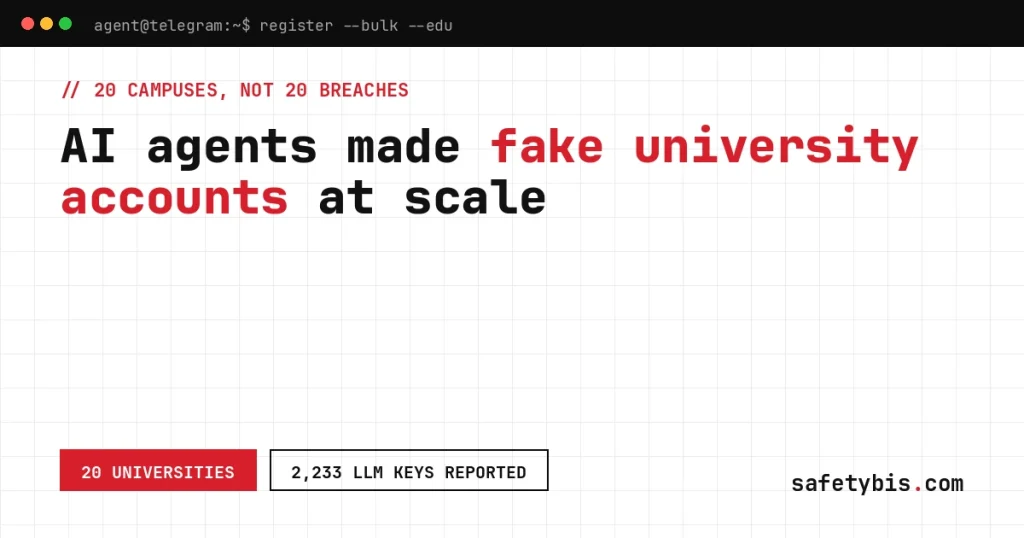
A research team says a Chinese-speaking actor it tracks as leepsmarts used AI agents controlled over Telegram to create fake university accounts and generate application payment links across 20 schools, 19 of them in the US. Read closely, the report describes fraud at most of those schools rather than 20 breaches, and that difference decides what each team should do this week.
Key takeaways
- Researchers say leepsmarts, a Chinese-speaking actor, touched 20 universities (19 US, one Argentina), but only 17 are named.
- Eight schools had fake university accounts created and five had application payment links generated; neither is a confirmed system intrusion.
- Harvard's 195 alumni records came from a torrent of the November 2025 ShinyHunters leak, not a new breach by this actor.
- The reported CVE-2026-41940 cPanel exploit against Utah, Arizona Christian and UTN Argentina was staged, not confirmed; the 2,233 stolen LLM API keys rest on a truncated source sentence.
What actually happened across the 20 universities?
A fraud operation touched 20 universities, and the researchers split them into four tiers. Only one tier involves anything resembling an exploit, and even that one is unconfirmed.
| Tier | Institutions | What the actor did | Confirmed intrusion? |
|---|---|---|---|
| Fraudulent accounts | NYU, UC Berkeley, Oregon State, UIUC, Colorado State, CSU East Bay, CSU Chico, Arizona State | Created accounts under false identities | No |
| Payment links | Stanford (summer session), UChicago, Wake Forest, Case Western, Central Michigan | Generated application payment links | No |
| Inherited leak | Harvard | Processed 195 alumni records from an old leaked dataset | No, per the researchers |
| Staged exploit | University of Utah, Arizona Christian University, UTN Argentina | Hardcoded as targets in a cPanel exploit | No confirmed compromise |
On 4 November 2026, a research team posted a summary to r/threatintel, cross-posted to r/blueteamsec, describing an actor it calls leepsmarts. The only profile given is “Chinese-speaking,” which describes language, not a government; the post makes no nation-state attribution.
The headline figure is 20 universities: 19 in the US and one in Argentina, the Universidad Tecnológica Nacional (UTN). Only 17 are named, and the post summarizes a longer writeup it does not link.
The researchers warned that “the impact varies a lot by institution.” If leadership hears “20 universities hacked,” they will send incident responders to problems that need a fraud analyst.
Which campuses got fake university accounts, and which only got payment links?
Eight schools had accounts created under fraudulent identities, and five had application payment links generated for them. The account tier covers NYU, UC Berkeley, Oregon State, the University of Illinois Urbana-Champaign, Colorado State, CSU East Bay, CSU Chico and Arizona State. The payment-link tier covers Stanford’s summer session, the University of Chicago, Wake Forest, Case Western Reserve and Central Michigan.
Neither tier requires breaking anything. Both use the front door every real applicant uses: a self-service registration page and an application-fee checkout. When a portal hands an account or payment link to anyone with a working email address, an automated agent can collect hundreds of them.
Application-fee fraud is a known pattern in higher education: synthetic identities or stolen cards paired with fee payment flows, then resold applications or accounts kept for student discounts and status verification. The post does not say which of these leepsmarts wanted.
What changed is cost. An AI agent that can read a page, fill fields and handle a verification email does this all night for nearly nothing.
Practitioner’s note: when we test self-service portals, we usually find no per-IP or per-device rate limit on account creation, email verification that accepts disposable domains, and payment links that stay valid for days without a verified session.
None of those show up in a vulnerability scan, because they are design decisions. Bot management and anti-scraping controls show how much automated signup traffic you already absorb.
Why the Harvard alumni records are a different problem
Harvard was not breached by leepsmarts, according to the researchers. The actor processed 195 Harvard alumni records from a torrent-distributed dataset tied to the November 2025 ShinyHunters incident, and the post says plainly: “This was not an intrusion by this actor.”
ShinyHunters is a data-theft and extortion group active since at least 2020. Once a dataset circulates on torrent, anyone can download it.
Inherited exposure calls for notification checks and monitoring of the affected people, for example for phishing that uses alumni details, not a forensic hunt through Harvard’s current systems. Report old leaks and new activity separately so leadership does not count the old leak as a fresh incident.
What about the CVE-2026-41940 cPanel exploit and the stolen LLM keys?
These are the scariest-sounding claims and the least proven. The University of Utah, Arizona Christian University and UTN Argentina appear as “hardcoded targets in a staged CVE-2026-41940 cPanel exploit, with no confirmed compromise.” Staged means prepared, not used successfully.
The post gives no affected versions or CVSS score, and we have not independently verified the CVE identifier, so check cPanel’s own advisory before acting on it.
The tooling is the new part. The operator ran two AI agent frameworks, Hermes Agent and OpenClaw, controlled over Telegram. The agents automated account registration, watched for new AI model releases and built the actor’s management dashboard.
The same pipeline reportedly harvested 2,233 LLM API keys from misconfigured cloud infrastructure. The source sentence is cut off there, so providers and misconfiguration type are unknown; treat the figure as low confidence.
Leaked model-provider keys usually get resold or used for free inference while the owner pays. An agent watching for new releases fits an operator who wants working keys ready, though that link is our reading, not the researchers’.
What should admissions and a cloud owner check this week?
Admissions teams own the most likely problem; anyone with LLM keys in the cloud owns the second.
Admissions and registration portals
- Pull applicant or student accounts created in recent months that never completed a real identity step: document upload, verified-card payment or contact with staff.
- Look for clusters created in bursts or sharing an email domain, device fingerprint, IP range or naming pattern.
- Review payment links generated but never paid, or paid with cards later disputed.
- Add rate limits and device checks to account creation and payment-link generation, and expire unpaid links quickly.
For in-house or heavily customized portals, education and edtech penetration testing covers these business-logic paths as well as the code.
cPanel hosts
- Inventory every internet-facing cPanel and WHM instance, including those run by departments or outside agencies.
- Compare versions against cPanel’s advisory for CVE-2026-41940 and patch.
- If you are one of the three named targets, review access logs.
LLM API keys
- Search repositories, environment files, storage buckets and CI variables for model-provider keys.
- Rotate anything outside a secrets manager, then check provider usage logs for the applications and IPs calling each key.
- Set spend alerts and per-key limits.
This applies to any business. A secrets and credential exposure assessment finds the keys you forgot existed.
What this writeup still does not prove
The Reddit post summarizes a longer writeup that is not available, so every claim rests on a few hundred words.
- Three of the 20 institutions are not named.
- There are no dates for the accounts, payment links, exploit staging or key harvest.
- No school is confirmed as compromised through cPanel.
- There is no count of fraudulent accounts or paid applications.
Until the full report appears, the honest summary is this: cheap AI agents made old-fashioned registration fraud fast, and most named schools need better identity checks, not breach response.
FAQ
Did leepsmarts breach Harvard?
No. The actor processed 195 alumni records from a torrent of the November 2025 ShinyHunters dataset, and the researchers say this was not an intrusion by leepsmarts.
How many universities were actually named?
17 of the 20: eight account-tier schools, five payment-link schools, Harvard and the three cPanel targets. The other three are not identified.
Are fake accounts the same as a hacked admissions system?
No. They come from abusing normal registration and checkout flows with false identities, which is an identity-proofing and rate-limiting failure, not a system compromise.
Should a company that is not a university check its LLM API keys?
Yes. The same pipeline reportedly collected 2,233 keys from misconfigured cloud infrastructure; search repos and cloud configs, rotate exposed keys and set spend alerts.
Not sure whether your signup forms, hosting panels or cloud keys would hold up against an agent running all night? Our penetration testing team can show you where the gaps are before someone else finds them.
Tell us what you're running
Scoping is free. We reply within one business day, and under 30 minutes for active incidents.