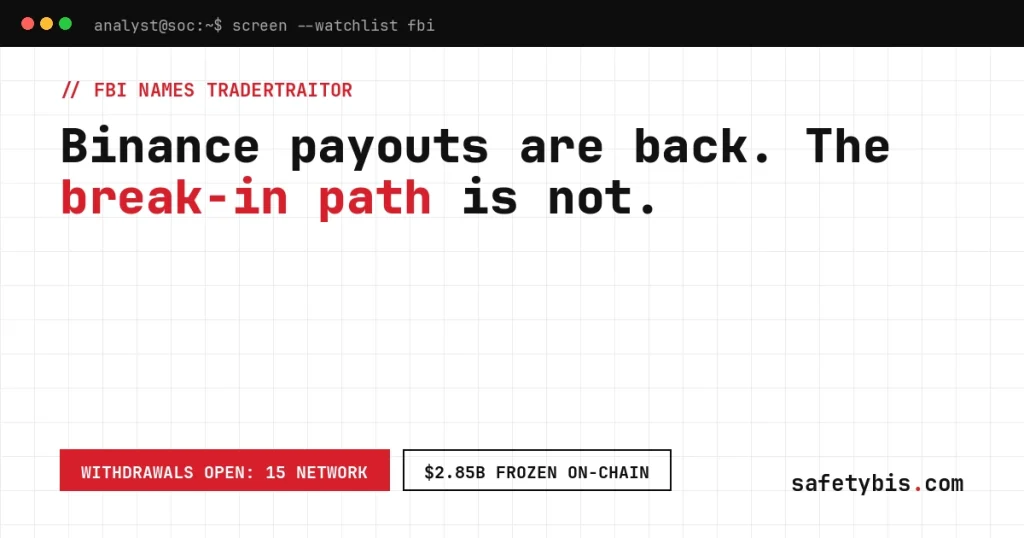
Binance reopened withdrawals on November 1, 2026, the same day the FBI named North Korea's TraderTraitor as the group behind the theft of more than $6 billion. Binance withdrawals after the hack are flowing again, and customers moved billions out on day one. What nobody has said is how the attackers got in. That gap limits what this incident can teach, but plenty of checks still apply to your own systems.
Key takeaways
- Binance restarted withdrawals in phases from 06:00 UTC on November 1, 2026, and later said all 15 networks were open while some assets were still being tested.
- Customers withdrew $4.649 billion and deposited $1.01 billion by 15:30 UTC, a net outflow of about $3.64 billion.
- About $2.85 billion of the reported $6.43 billion is frozen on-chain by Tether, Circle, Ripple, Arbitrum and Optimism; a freeze is not a recovery.
- The FBI named TraderTraitor (also Jade Sleet, UNC4899) but has not said how Binance was breached.
- The group's documented lures, fake recruiters and poisoned Terraform providers, target engineers and CI pipelines at crypto firms directly.
Are Binance withdrawals after the hack actually open again?
Yes, with a caveat in the wording. Binance restarted withdrawals in a first phase between 06:00 and 09:00 UTC on Sunday, November 1, 2026, after pausing them in the wake of the October 29 theft. Deposits stayed open throughout, and the exchange says the incident never affected them.
Binance’s stated reason for the phased restart:
“Since the incident, our teams have taken precautionary measures to safeguard the platform, conducted security assessments, and worked to verify the readiness of affected services. We aim to restore withdrawals progressively as we complete security and readiness checks.”
A later update said withdrawals had resumed on all 15 networks, while the team was still “rigorously” testing the remaining networks and assets. Read together, those two lines mean an open network does not guarantee that every token on it is open.
If your finance team needs a specific asset to pay a supplier or run crypto payroll, check that asset’s withdrawal status inside the account before you schedule the payment. The headline announcement is not enough.
Who pulled money out once payouts restarted?
Customers did, in volume. Binance says that between 06:00 and 15:30 UTC on November 1 it processed $4.649 billion in withdrawals and $1.01 billion in deposits, a net outflow of about $3.64 billion in roughly nine and a half hours. That is about two and a half times the entire Bybit theft of February 2025.
Both readings of that number hold. The platform paid out billions without halting again, which says something about liquidity. And a large share of customers chose, on the first day they could, to put their money somewhere else. Both figures come from Binance; no independent party has published its own count.
For a business: this is a counterparty decision, not a panic decision. Ask how much operating cash really needs to sit on any one exchange, and for how long. Our first-day Binance hack business checks covered balances and signers. That list still applies, and the checks at the end of this article build on it.
How much of the stolen crypto is frozen, and how much can still move?
About $2.85 billion is frozen on-chain, roughly 44% of the reported $6.43 billion. Tether, Circle, Ripple, Arbitrum and Optimism carried out the freezes.
The headline number itself varies. The main reporting cites $6.43 billion, the FBI says “more than $6 billion,” and our October 29 Binance security incident report used the earlier $6.3 billion estimate.
Crypto losses are priced in dollars at a moment in time, so totals drift with prices and with which transfers analysts decide to count. Treat $6.43 billion as the current reported figure, not an audited one.
The funds left across 11 blockchains, up from the “at least ten” in first-day reporting. Ethereum and Bitcoin held 82% of the value.
Why only part could be frozen comes down to who controls the asset. Stablecoins such as USDT and USDC have issuers that can block tokens on supported networks. Native BTC and ETH have no issuer, so nobody can blacklist a wallet balance.
That explains what the FBI, the U.S. Secret Service and IRS Criminal Investigation say they have observed: the attackers are converting the stolen assets primarily into Ethereum. The FBI expects the next laundering steps to run through DeFi and instant swap services.
Do not read the freeze as recovery. A freeze stops specified tokens from moving. It does not transfer ownership, reimburse anyone, or prove that every frozen unit came from this incident. The remaining $3.58 billion or so is a subtraction result, not a confirmed laundered or lost figure.
The FBI also published the wallet addresses it ties to the laundering. We do not reproduce them here; the screening section below explains how to use the original list.
What did the FBI attribute, and what did it leave out?
The FBI attributed the theft to TraderTraitor, a North Korea-aligned group. Vendors track the same operators as Jade Sleet (Microsoft’s name), Pressure Chollima, PUKCHONG, Slow Pisces and UNC4899. If your threat intel feed and your MDR provider use different names, they are describing the same group.
TraderTraitor has been active since at least 2020 and has been tied to heists at DMM Bitcoin, Bybit, KelpDAO and Bitget. Its signature move is persuading victims to download malware-laced applications, often presented as part of a hiring process.
At the reported figures, the Binance haul is about 4.4 times Bybit’s $1.46 billion loss in February 2025, which makes it the largest cryptocurrency theft on record. Elliptic said “this single incident almost doubles the total cryptoassets stolen by the regime,” a total it puts at over $6.5 billion in recent years.
Did Binance say how the attackers got in?
No. Neither Binance nor the FBI has published the intrusion path. The attribution answers who; it does not answer how.
In the first days, Binance pointed to a compromised laptop and then said it had found additional points of breach. Nothing published since has filled in that picture.
The reporting on TraderTraitor’s current tradecraft comes from separate research by SentinelOne, Zscaler ThreatLabz and Microsoft. None of it says this tradecraft caused the Binance breach. “North Korea did it” and “they got in through a developer” are two different claims, and only the first is on the record. Keep them separate in risk discussions.
How does TraderTraitor reach staff without touching an exchange?
Through people and pipelines. The group’s documented approach starts with a believable job offer and ends with malware on an engineer’s laptop or inside a build system.
The recruiter lure
The pattern mirrors Lazarus Group’s Operation Dream Job and Famous Chollima’s Contagious Interview: a polished recruiter, a software engineering role, an interview, and eventually code the candidate is asked to run. The group now uses AI to write the outreach, build fake personas and evade detection, which makes the personas harder to spot.
Microsoft described Jade Sleet posing as recruiters for a spoofed AI-powered blockchain intelligence company, using tailored domains, social media profiles and industry knowledge to schedule interviews with software engineers. In the same short window, it ran similar job-themed targeting through two more front companies on comparable infrastructure.
The reported targets include people at cybersecurity, AI, blockchain and talent recruitment companies. Recruiters on that list deserve attention: a compromised recruiter account would deliver the next lure from a genuine inbox.
The poisoned Terraform provider
SentinelOne and Zscaler ThreatLabz describe trojanized Terraform providers as a delivery route. At a high level, the chain runs like this:
- A poisoned provider runs a Bash loader that fetches malware matched to the victim’s operating system.
- FLATROOF, a cross-platform implant, collects sensitive data through a Python-based information stealer.
- ROOFDECK, a backdoor, then gives the attacker full remote control.
The chain runs on macOS, Linux and Windows, which covers most developer laptops and CI runners. There is no CVE and no patched version, because nothing in Terraform is broken. A provider is an executable plugin, not a passive config file.
When Terraform runs, provider processes inherit whatever the user or CI runner can reach: cloud credentials, CI secrets, source-code tokens and, in a crypto firm, sometimes signing material.
Terraform’s dependency lock file records provider versions and checksums. A matching checksum proves the package has not changed since someone accepted it. It does not prove the package was safe when they did.
What to change on the engineering side
- Ban running interview code on company machines. If a candidate’s task has to be reviewed, open it in a disposable VM.
- Pin Terraform providers to known registry sources and send every unexpected lock file change to a human reviewer. Our CI/CD pipeline security work starts at exactly that point.
- If a runner looks compromised, preserve CI logs, provider caches, lock files and cloud audit logs before rebuilding, and do not run plan or apply to “see what happens.” Rotate runner secrets from a clean host and check where they were used.
Why should regulated crypto and e-money firms test this path now?
Because their engineers match the target list closely. Electronic money institutions and crypto-asset service providers often run small engineering teams, hire remotely and rely heavily on infrastructure-as-code. That profile fits the recruiter-plus-Terraform playbook almost exactly.
In the EU, DORA applies to both e-money institutions and CASPs authorized under MiCA. It expects regular testing of ICT resilience, and entities designated by their authority must run threat-led penetration testing against live systems.
TraderTraitor’s documented playbook is close to a ready-made scenario for that test: a recruiter message to an engineer, code run on a work laptop, a pivot into CI, and a reach for whatever approves or signs withdrawals. Run as DORA penetration testing, the exercise shows whether your SOC notices each step and gives your supervisor the scope and reporting it expects.
What we see in engagements: the weak link is rarely the hot wallet itself. It is the CI runner holding long-lived cloud admin credentials, the developer who ran a “take-home test” on a corporate laptop, and the trading bot API key granted withdrawal rights during setup and never trimmed. Any one of those turns a single phishing success into reach over money.
What should you check before moving funds, and how do you screen the FBI list?
Start with the access you control, then screen your flows against the FBI’s addresses. Neither step depends on knowing how Binance was breached.
Your Binance account
- Who can withdraw: list every user with withdrawal rights and remove leavers and shared logins.
- API keys: disable withdrawal permission on any key that only trades, and restrict keys to fixed IP addresses.
- Allow-list: review every withdrawal address and flag anything added since October 29.
- Sessions and devices: check recent sign-in devices, end sessions you do not recognize and re-enroll 2FA from a clean device.
- Test first: send a small withdrawal on the exact network you intend to use before moving a large balance.
Frozen attacker funds say nothing about your own balance. Binance said in earlier reporting that it would cover losses; the November 1 update concerns resumed withdrawals, not a new reimbursement promise.
Screening against the FBI addresses
- Save the FBI’s original list with the date you retrieved it, and load it from that copy, not from a forwarded spreadsheet.
- Add it to your blockchain analytics or transaction screening tool as a watchlist for both incoming deposits and outgoing withdrawals.
- Screen backwards from October 29, not only from today. Laundered funds often reach regulated services days later, after DeFi and swap hops.
- Match on network as well as address. The same EVM address format exists on several chains, so record the transaction hash, network and timestamp for every hit.
- On a match, follow your AML procedure: hold the funds, document the trace and report to your financial intelligence unit. Contact issuers, exchanges and law enforcement only through verified channels, because fake “recovery” contacts follow every big heist.
FAQ
Are Binance deposits and withdrawals both open after November 1?
Yes. Deposits never closed, and Binance says withdrawals resumed on all 15 networks after a first phase between 06:00 and 09:00 UTC on November 1. Some assets were still under testing, so check the status of the specific token you need.
Why do figures say $6.3 billion, more than $6 billion and $6.43 billion?
Crypto losses are valued in dollars at a point in time, and different sources count different transfers. The FBI says more than $6 billion; current reporting uses $6.43 billion. Treat it as an approximate figure.
Does a freeze by Tether or Circle mean the stolen coins are back?
No. A freeze stops the tokens from moving but does not return them to anyone. Native BTC and ETH cannot be frozen this way, which is consistent with the FBI's observation that the attackers are converting mainly into Ethereum.
Did the FBI say how North Korea got into Binance?
No. The FBI attributed the theft to TraderTraitor but did not describe the intrusion path. Research on the group's fake-recruiter and Terraform-provider lures is separate and has not been linked to this breach.
Is the Binance hack bigger than the Bybit hack?
Yes. At the reported $6.43 billion it is about 4.4 times Bybit's $1.46 billion loss in February 2025, making it the largest cryptocurrency theft on record.
Should my business withdraw everything from Binance?
That is a counterparty decision. First lock down who can withdraw, trim API key permissions and review your allow-list, then keep on any exchange only the balance you actually need for operations.
If funds have already moved from one of your wallets or exchange accounts, our crypto hack incident response team can contain the affected endpoints and build the chain-specific evidence that issuers and investigators need.
Tell us what you're running
Scoping is free. We reply within one business day, and under 30 minutes for active incidents.